Sir Segwarides
Le Morte d'ArthurSir Segwarides is an earl’s husband and a knight in the Cornish court whose connection with Sir Tristram turns a private love triangle into a recurring test of loyalty and judgment. Although he first has strong cause to resent Tristram, he eventually refuses to let that grievance govern him: on the Isle of Servage, he offers Tristram friendship and practical aid, and afterward receives the island’s lordship from him. His story moves from suspicion and rivalry toward an alliance grounded in mutual service.
Identity and Place in the Story
Sir Segwarides is identified as the husband of a lady who loves Sir Tristram and whom Tristram also loves. His place in the narrative is therefore relational as well as chivalric: he is at once the injured husband, a pursuer who confronts Tristram, and later a companion who helps him in danger. The text does not give him a personal history beyond these relationships and episodes, but his changing response to Tristram supplies a clear thread across them.
The marriage is first described after Tristram returns to Cornwall and resumes life at King Mark’s court. Tristram and King Mark both love Sir Segwarides’s wife, and she loves Tristram in return. When she sends a dwarf to summon Tristram, she warns that he must come armed because her lover is a formidable knight. King Mark discovers the message by questioning the dwarf under threat, then secretly prepares an ambush with two knights. Tristram is wounded in the encounter and knocks King Mark down, though he does not know who attacked him. Sir Segwarides is not present in this first clash; his role begins when Tristram reaches the lady.
Confrontation with Tristram
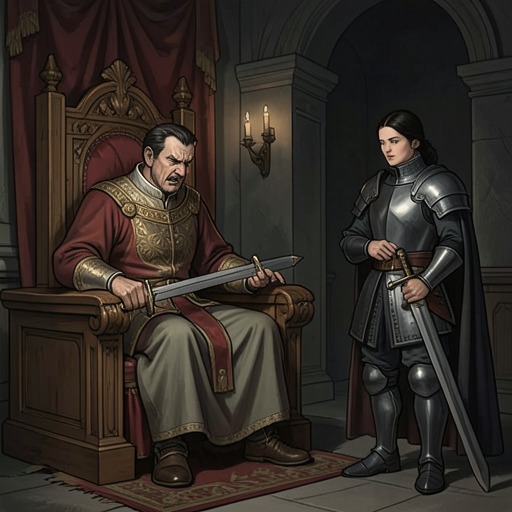
The lady receives Tristram, but a warning that her husband is close sends him away. When Sir Segwarides arrives and discovers that a knight has been there, he threatens her until she identifies Tristram and says that he has left, already wounded. Segwarides arms himself, rides after him, and catches him on the road toward Tintagil. He attacks with a spear, which breaks, and then continues with his sword. Tristram urges him to stop, acknowledging the wrong he has done and saying he will hold back as long as he can. Segwarides refuses to end the encounter, insisting that one of them must die; Tristram then defeats him and leaves him unconscious.
Segwarides’s men find him in the field and carry him home. He remains wounded for a long time but recovers. The aftermath is marked by concealment and silence: King Mark keeps his own meeting with Tristram secret, while Tristram does not realize that his attacker was his uncle. Mark’s attendants later come to comfort the sick Tristram. Although the court’s public speech suggests that matters have been forgiven and forgotten, the account says that Mark never again truly loved Tristram. Segwarides, meanwhile, does not renew the fight, both because of Tristram’s prowess and because Tristram is Mark’s nephew; the narrative also notes that a man with a private injury may be reluctant to expose it to public shame.
The Lady’s Departure and Tristram’s Response
The relationship resurfaces when Sir Bleoberis de Ganis comes to King Mark’s court and asks for whatever gift he chooses. Mark grants the request, and Bleoberis selects Sir Segwarides’s wife as the fairest lady in the court and takes her away. Segwarides arms and rides after him to recover her. The court is angered, and some ladies rebuke Tristram for allowing a woman connected with his love to be taken. Tristram answers that it is not his place to intervene while her husband is present; if Segwarides fails, however, he may still act.
When word arrives that Bleoberis has overcome and badly wounded Segwarides, Tristram sets out after the knight. The lady later explains the point of her disappointment directly: she had trusted and loved Tristram, but he had not immediately rescued her, instead allowing her husband to pursue her. She says she will leave Tristram and will not go with him, even if he had defeated Bleoberis. Her decision makes the earlier restraint consequential: what Tristram understood as deference to a husband, she experienced as abandonment.
Bleoberis recognizes Tristram’s distress and offers to give the lady to him if she will go. She refuses, and Bleoberis resolves to return her to her husband, in part for Tristram’s sake. Tristram says that he will be more cautious about whom he loves or trusts. Bleoberis takes the lady to the abbey where Segwarides is recovering and delivers her to him. She tells Segwarides that Tristram fought Bleoberis and had her brought back, a report that pleases her husband. Thus the rescue restores the marriage’s immediate circumstances while leaving Tristram chastened by the lady’s refusal.
Reconciliation on the Isle of Servage
Later, Tristram arrives on the Isle of Servage with his wife, Isoud la Blanche Mains, and her brother, Sir Kehydius. A storm drives their small barge onto the coast, where it breaks apart and Isoud is hurt; they make their way into the forest. There Tristram encounters Segwarides beside a well, accompanied by a damsel. Segwarides recognizes him as the man he has most reason to hate because Tristram had separated him from his wife’s affection. Yet he immediately distinguishes the grievance from the knight: he says he will not hate a noble man over a fickle lady, asks Tristram to be his friend, and offers his own friendship in return. The island is dangerous, and the men will need to help one another.
That offer reverses the earlier pursuit. Where Segwarides once followed Tristram to answer a marital injury by combat, he now meets him in peril and chooses cooperation. He introduces Tristram to a Cornish-born lady, who explains that knights who enter the valley are usually captured or killed. Tristram announces his intention to free the island from Sir Nabon, presenting his previous deeds as grounds for undertaking the challenge. The account places Segwarides alongside him in the threatened landscape, not as a rival but as an ally.
Lordship and Narrative Significance
After Tristram kills Sir Nabon and Nabon’s son, the people of the island offer to submit to him. Tristram refuses to take the territory for himself and proposes that Sir Lamorak de Galis should rule, recognizing the deeds Lamorak has performed there. Lamorak declines, saying that he has not earned the lordship as fully as Tristram. Tristram then gives the island to Segwarides, who accepts the gift and governs it honorably. He releases all the prisoners and establishes good governance in the valley.
The change in Segwarides’s position is concrete: the husband who once pursued Tristram over a private injury becomes the recipient of land and responsibility through Tristram’s judgment. His rule is not merely a reward; the release of prisoners and restoration of order show what he does with it. Returning to Cornwall, he reports Tristram’s advancement of him to King Mark and La Beale Isoud, and the adventures of Tristram and Lamorak become publicly known. La Beale Isoud is deeply distressed to hear that Tristram has married Isoud la Blanche Mains.
Across these episodes, Segwarides’s importance lies in the contrast between an old grievance and a new act of trust. The narrative does not erase the damage caused by his wife’s attachment to Tristram, but it allows Segwarides to name that history without repeating its hostility. His eventual friendship, public responsibility, and governance turn a story of jealousy into one of changed allegiance and reciprocal aid.